
Cyril E. King Airport sits on the southwest coast of St. Thomas, on the shore of Lindbergh Bay, roughly 3 km from Charlotte Amalie and ten minutes away by road. The runway runs out toward the water, which is why the approach looks like it ends in the bay until the last few seconds.
One terminal building, two floors, eleven gates. Two maps follow: a plan of the terminal drawn for this guide, and an interactive version you can zoom.
St. Thomas Airport Map
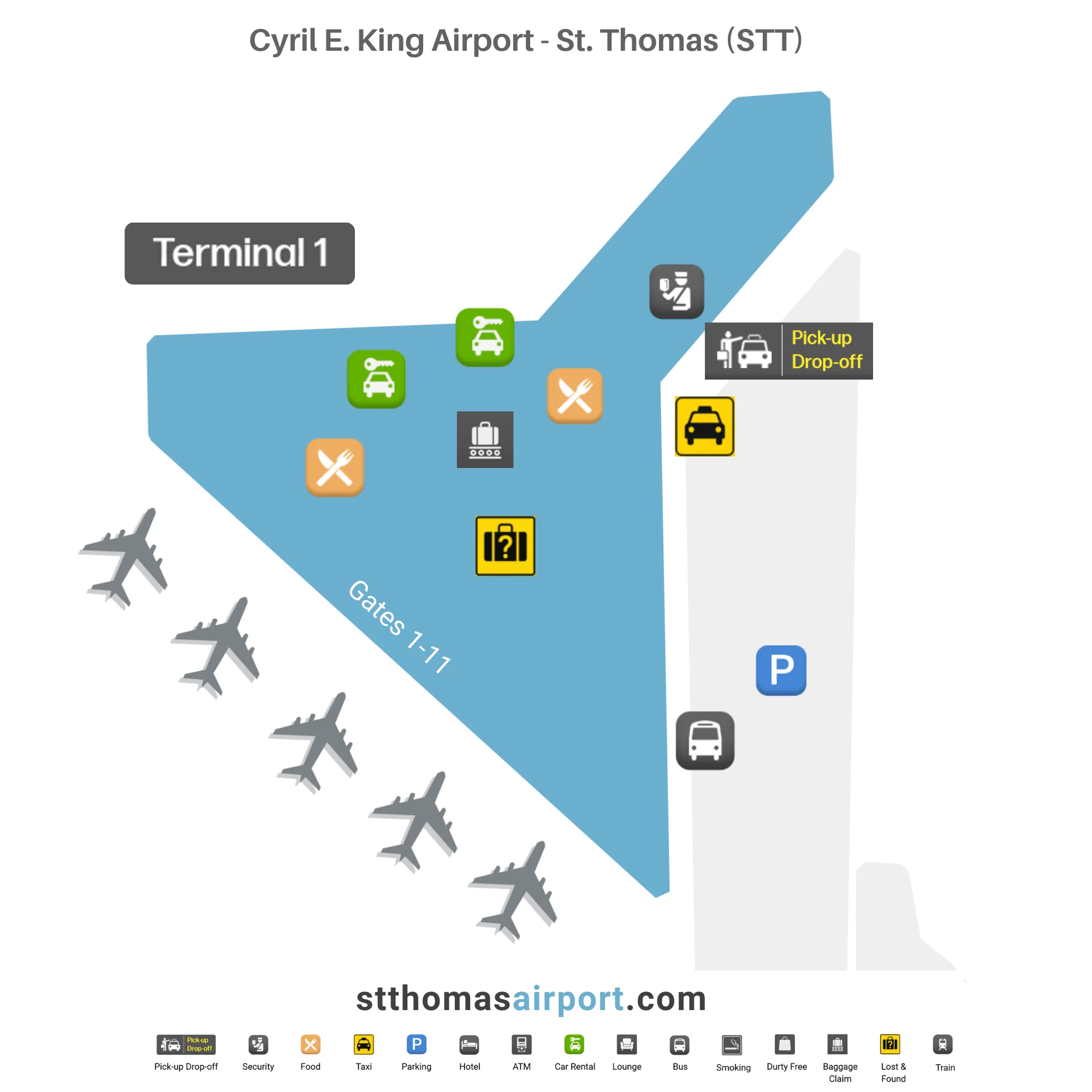
This plan was drawn for this guide rather than reproduced from the operator, and it follows the building the way passengers actually move through it: the check-in counters, the customs and security checkpoints, the gate line, and the baggage claim area with its exits. Open it in a new window to see it at full size.
Signage inside the terminal is thin, particularly around the customs queue, so the plan is most useful before you arrive rather than once you are standing in the line.
Interactive Cyril E. King Airport Map
Cyril E. King Airport (STT) is the primary gateway to St. Thomas and St. John in the U.S. Virgin Islands. Located just west of Charlotte Amalie, its runway extends into the turquoise waters of Lindbergh Bay, offering one of the most scenic Caribbean landings where your vacation begins the moment you touch down.
The interactive version zooms and pans, which is the better option on a phone at the curb. Use it to locate a specific gate, a food outlet or the rental desks. The drawn plan above is easier to take in as a whole; this one is easier to search.
How the Terminal Is Organized
There is one terminal building. No Terminal A, no Terminal B, no pier and no shuttle. Once you are through security, every gate is a walk.
The Port Authority names three areas and everything at this airport sits in one of them: the Domestic Passenger Lounge on the departure side past security, the Domestic Baggage Claim on the arrivals side, and the Commuter Inter-Island Gates, numbered 10 and 11, for short regional services.
Check-in is on the ground floor. The gates are on the same floor, as is baggage claim. The first floor carries 190,000 square feet of the building against 60,000 upstairs, which means check-in, the gate line and the carousels are all on one level and there is no reason to change floors between the door and the aircraft. What is open in each area is set out on the terminal guide.
Check-In and Security
Airline counters and self-service kiosks are together on the ground floor.
Passengers departing for the U.S. mainland or Puerto Rico then clear U.S. Customs and Border Protection before they reach security. The customs queue forms behind the check-in kiosks and reaches the curb on heavy days, which is the one thing a map of this airport most needs to show.
Allow three hours for a mainland departure. That is longer than a domestic flight normally needs, and the customs inspection is the reason. The check-in page sets out the full sequence and the airline bag drop deadlines, which are earlier here than at most U.S. airports.
The security checkpoint is small. Queues build back from it rather than spreading beside it, so the wait runs longer than the space suggests. Standard TSA rules apply. Carrier-specific requirements are on the airlines.
Baggage Claim and the Way Out
Baggage claim is on the ground floor and it is not a large hall.
Arriving passengers from the mainland and Puerto Rico clear nothing on the way in. There is no immigration line and no customs check, so the route is aircraft, carousel, doors. The baggage claim page covers carousel screens and what to do about a missing bag.
Cruzan Landing Bar, Cardow Liquor Store and Tobaccoist sit in this area, which is why an arriving passenger can buy liquor without leaving the building.
Ground Transport at the Door
Taxis wait immediately outside the arrivals doors and work to the flight schedule rather than a timetable. Fares run on set government rates rather than a meter, so agree the figure before you load the bags. See taxi for the rate structure.
Car rental desks operate both inside the terminal and just outside it. Booking ahead means collecting a key at the desk instead of queuing for whatever is left. See car rental.
Drivers dropping off or collecting should read parking first. The short-term area is tight when several mainland flights land together.
Frequently Asked Questions
No. Cyril E. King Airport operates from a single terminal building on two floors with eleven gates. There is no Terminal A or Terminal B, no separate pier and no inter-terminal shuttle. Every gate is reachable on foot once you are through the security checkpoint.
The ground floor. Airline counters and self-service kiosks are together there, alongside the entrance from the drop-off area. Baggage claim is on the same floor, which is why the walk from the carousel to the taxi rank is short. Departing passengers move from check-in to customs, then security.
Taxis wait directly outside the arrivals doors, on the ground floor, and run to the flight schedule rather than a fixed timetable. Car rental desks operate both inside the terminal near baggage claim and immediately outside it. Both are a short walk from the carousel because the building is small.